
From the app to a real chessboard
Rookaby needs no chessboard: everything happens on the screen, so a lesson never waits for a grown-up to fetch a wooden set. But one day your child will want to hold real pieces. Here are five short games to play on a real board, in the same order as the app.
Any board will do. For small hands, a board of about 40 by 40 centimetres with medium-sized pieces is a good size. Keep each game short and stop while it is still fun.
1. Meet the pieces
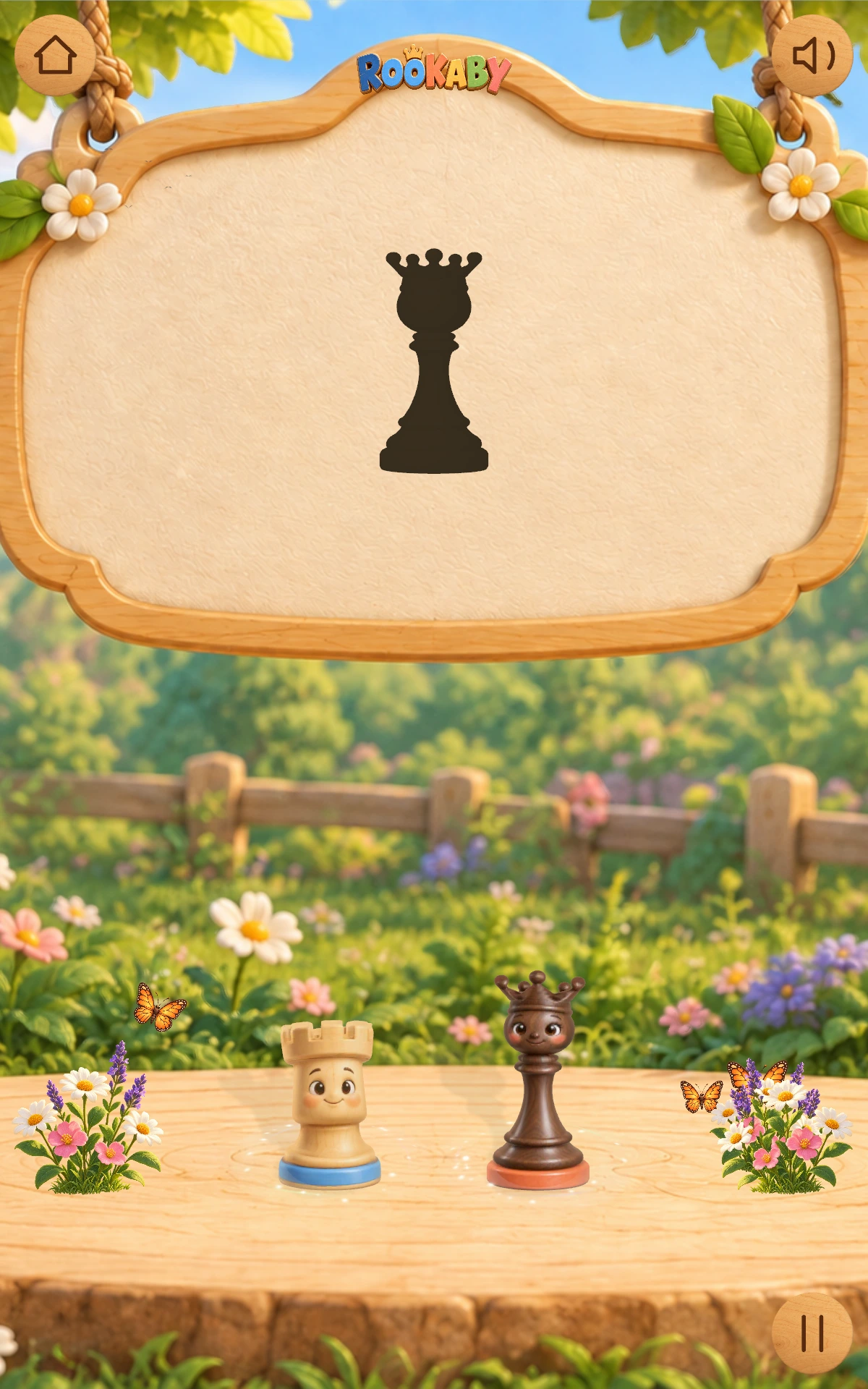
Put the six different pieces on the table and give each one the name your child knows from the app: Bonk the rook, Wispel the bishop, Hoppe the knight, Solla the queen, Poffel the king and Peppel the pawn. Ask for one by name, or hide one and see which friend is missing. Then sort them into two houses, the light pieces and the dark ones.
2. Take turns with the rooks
Put one rook on each side of the board. Your child moves a rook along a straight road, then you move yours. That is the whole game, and it practises waiting for each other. A rook is the easiest piece to start with, because it always walks the same way.
3. Reach the star
Put one piece on the board and a small treat or a coin on another square as the star. Your child walks the piece there by its own rule. Then move the star. Dutch school chess has a version called "eating carrots", with pawns as the carrots.
4. To the other side
This is the first real board game, and children play it in the app too. Give each player four pawns on the row in front of them: yours on the first, third, fifth and seventh column, your child's on the other four, so no pawn ever blocks another. Take turns walking one pawn one square forward. The round only ends when everyone is across, so there is a finish and nobody loses. A race with pawns is one of the first games chess teachers use.
5. Every piece goes home
Put the pieces next to the board and show your child the home square of each one. Start with a few pieces and add more later. Setting up the whole starting position is one of the harder parts of chess for young children, so do it together and do not rush it.
When to play a whole game
A whole game asks for every move, taking, check and mate, and for the patience to lose. Chessity, a Dutch online chess school, puts the start of real chess lessons at about six, and the Dutch chess federation lists the Steps Method as suitable from about five. Until then, small games like these are the right size. In Rookaby, taking, check and mate come later as puzzles with an answer, never as a match your child can lose.
When your child reads and wants whole games, a chess club or an app for older children is a good next step. Our page chess apps for children who can't read yet compares several.
Sources
Checked on 15 November 2026.
- Shymanskyi, Online platforms and traditional chess teaching for preschoolers, 2025
- KNSB, School chess for groups 3 to 5 (in Dutch)
- CSEN, Model of a chess course for primary schools (Erasmus+)
- Gorlova, Kulpin, Frolova and Nikitina, Learning through play: the didactic potential of chess in preschool education, Review of Pedagogical Research, 2026
- KNSB, Learning chess for young players (in Dutch)
- Chessity, What is the best age to teach your child chess? (in Dutch)