
Can a two- or three-year-old learn chess?
Part of it, yes. A child of two or three can learn the names of the pieces, sort them, put them on squares and take turns. A whole game, with winning and losing, usually waits until about six. Below is what people who teach young children say, and how we built Rookaby around it.
What a two- or three-year-old can do
Children this young learn through their hands and their ears. They can hear a piece's name and find it again, put the light pieces with the light ones, move one piece across a few squares and wait while someone else has a turn. Story Time Chess, a chess school in New York, teaches children from three and tells each piece's story first. Ernest Colding, a chess master who has taught children for forty years, has introduced chess ideas to children as young as two, and adds that most of them are not ready for real lessons yet.
At this age, aim for the pieces to become friends: familiar faces with names, each with its own way of walking.
What waits until later
A full game asks for a lot at once: six different moves, taking, check, mate and a few special rules. Teachers of four- to six-year-olds in kindergartens found that setting up the starting position, the words of the board and the harder moves were the most difficult parts. The Dutch chess federation lists the Steps Method, used by many Dutch clubs, as suitable from about five. And under five, losing is hard: a game you can lose is easily a game a small child walks away from.
How young children learn it best
- Teachers start with one easy piece, such as the rook, and leave the pawn until later, because it takes differently from how it walks.
- Each piece becomes a character, and its move becomes something it does for a reason. FIDE's early-years programme also teaches children to see the pieces as characters.
- Short sessions with something to do and to see work better than long explanations.
- Play together and keep it light. If it starts to feel like work, try again in a few months.
What chess will not do
You may read that chess makes children smarter. The largest review of the research, by Sala and Gobet in 2016, found only a modest effect on school and thinking skills. We do not promise that. Chess is worth learning because it is a lovely game to play together.
How Rookaby fits
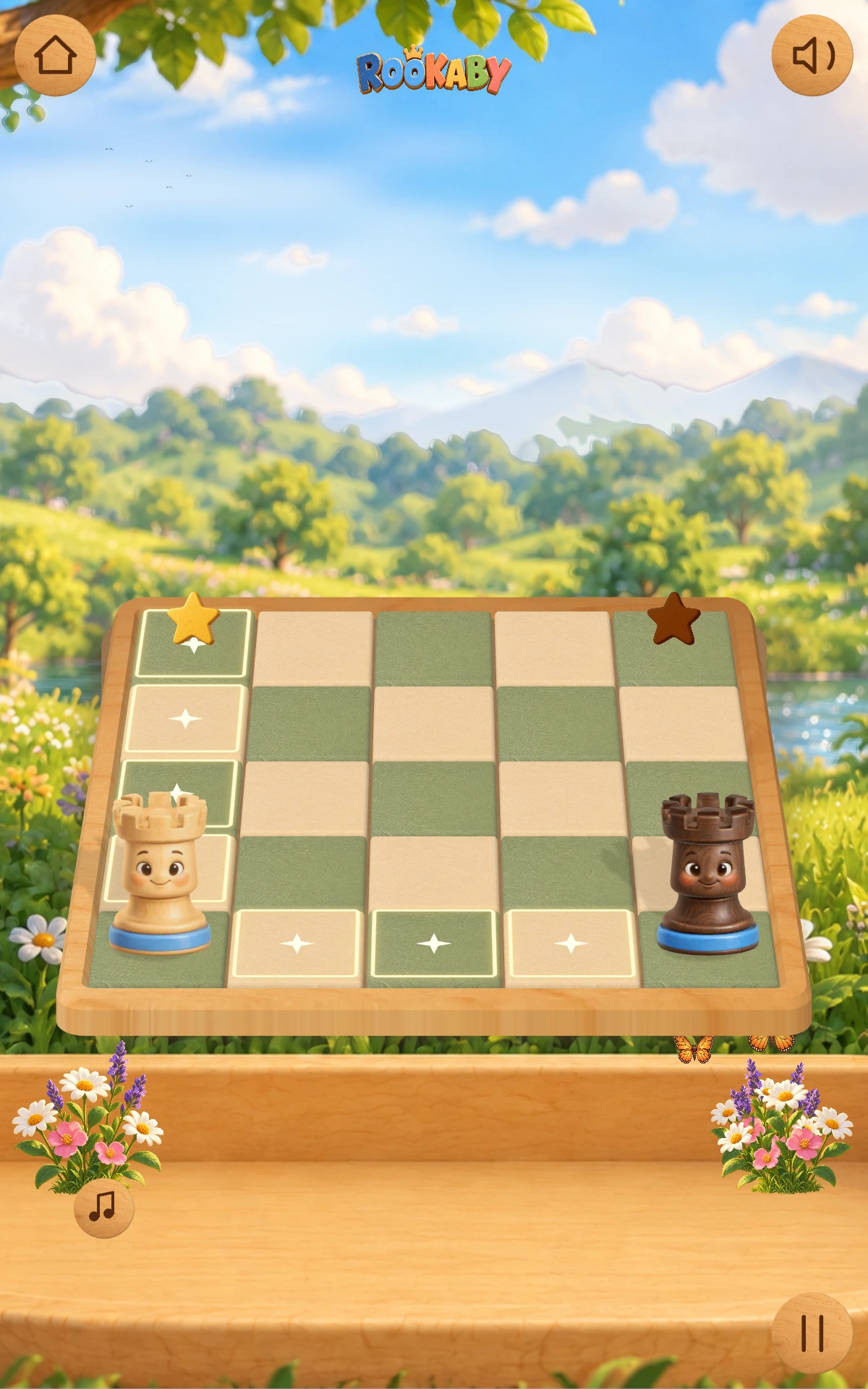
Rookaby is our app for children aged 2 to 6. Every lesson is read aloud, so your child needs no words on screen. Watch the pieces: they come out to play by themselves, and every one you touch answers. Six characters, six stories, each one explaining why that piece moves the way it does. Tell Rookaby how old your child is, and the pace, the shelves and the puzzles follow. There are no timers, no scores and no way to lose. The first stage is free.
Sources
Checked on 15 November 2026.
- Story Time Chess, Frequently Asked Questions
- Ernest Colding, What age should children start chess?
- Gorlova, Kulpin, Frolova and Nikitina, Learning through play: the didactic potential of chess in preschool education, Review of Pedagogical Research, 2026
- KNSB, Learning chess for young players (in Dutch)
- CSEN, Model of a chess course for primary schools (Erasmus+)
- FIDE, Early Years Skills
- Sala and Gobet, Do the benefits of chess instruction transfer to academic and cognitive skills? A meta-analysis, Educational Research Review, 2016